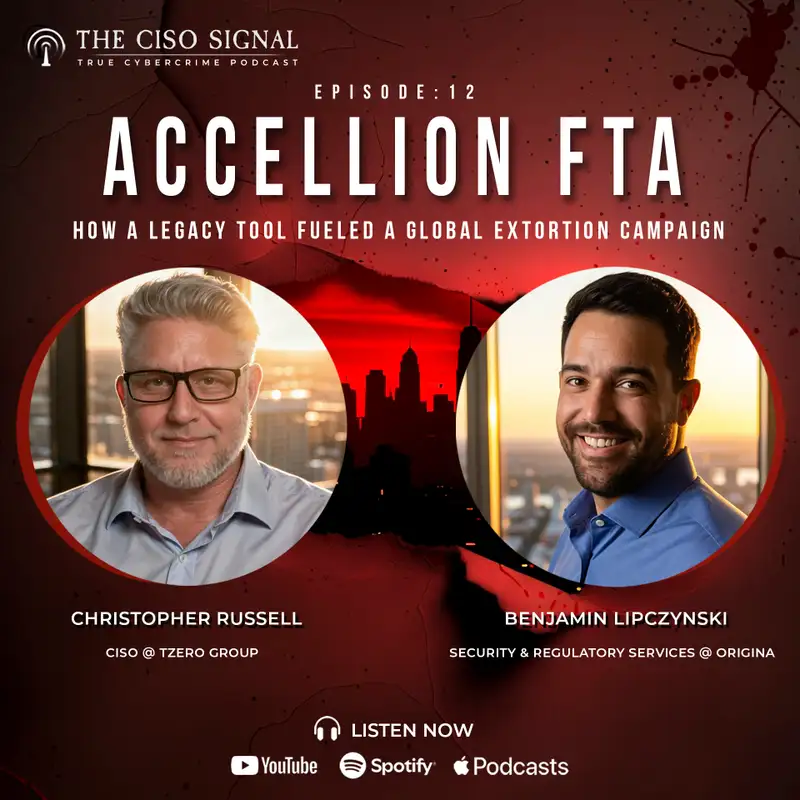
Accellion FTA | How a Legacy File Transfer Tool Fueled a Global Extortion Campaign
The initial signals from the reports was
a was a ransom note.
By the time you see
that, it's a little bit too late.
The threat actors in your house,
the attack surface area can be so massive
you can be overwhelmed
with all the intelligence.
So the challenge really becomes
what's critical to you.
Where do you focus?
Welcome to The CISO Signal
True Cybercrime podcast.
I'm Jeremy Lander.
In late 2020, cybercriminal groups
discovered a weakness in a system
used by hospitals,
universities, financial institutions
and government agencies around the world.
Not a new platform.
An old one Accellion FTA. A file transfer
appliance designed
years earlier
to solve a very specific problem
how to move large, sensitive files
between organizations
without exposing the rest of the network.
In its day, it was cutting edge,
secure corridor
connecting institutions,
a dark box
and a network closet
that did one job quietly and did it well
for nearly 20 years,
organizations like Kroger,
the reserve Bank of New Zealand,
and the University of California
trusted that corridor
with their most valuable data.
Then attackers found it.
What followed was not a single breach,
but a coordinated campaign,
one focused on data theft
and another on pressure,
and in some instances,
seven figure ransom demands.
While defenders tried to understand
what was happening.
Deadlines were already being set,
data was already gone,
and questions were already being asked
not just by attackers
but by regulators, by boards, by lawyers.
Questions like why was the system
still running, who owned it?
And how many other organizations
were exposed in the same way?
This is the story of the Accellion breach,
and to help us answer those questions,
were welcoming back to the podcast.
Christopher Russell
Chris is the CISO at tZERO Group,
bringing deep experience
in threat intelligence,
legacy system risk and incident response,
and joining
Chris and I is
Benjamin Lipczynski
Director of Security
& Regulatory Services
at this episode's sponsor -
Origina. Origina helps enterprises
safely operate, govern,
and extend mission critical systems
that may have outlived
their original vendor support models.
Ben brings
more than 20 years of experience
across
defense, critical infrastructure,
and rapid incident response,
helping organizations reduce risk,
preserve stability
and regain control
without being forced
into rushed,
expensive or unnecessary upgrades.
Ben.
Chris, it's great
to have you both on the show.
How are you gentlemen doing this evening?
Really good.
Jeremy, thanks for having me.
Very well. Thank you for having me.
Excellent.
Let's begin the investigation.
We are in the midst of a ceaseless war.
Not of bombs or bullets, but of breaches,
firewalls and silent incursions.
The targets?
Our borders are banks, our commerce
and the critical infrastructure
that underpins a free civilization.
The enemy is cloaked in code,
fueled by greed,
glory, and a desire for chaos.
This is the story of the unseen
protectors, the nameless
generals, the CISOs,
chief information security officers.
They are the guardians at the gate.
Watchers on the wall.
Ever vigilant and always listening
for The CISO Signal.
For deeper
breach timelines and regulatory analysis
that you can't find anywhere
else, visit theCISOsignal.com
or subscribe to our LinkedIn newsletter.
Act I.
The Corridor: Accellion FTA, was built
to be a corridor,
a controlled passage for sensitive files
to move
between organizations
without needing to open every door
in the building.
Contracts, records, regulated data,
the kinds of files
that do not get a second chance
if they end up in the wrong hands.
This corridor was designed
to be predictable,
invisible, uneventful in the way
critical infrastructure
is supposed to be uneventful.
Quarter closes come,
regulatory reporting happens.
Patient intakes need to be done.
Moments
when the business
cannot afford surprises.
And because it never caused problems
in the past, it stayed open, not
because it was perfect,
but because it was relied upon.
Ben before the breach even begins,
help us set the stage.
When you look at a decades old system
like Accellion, still patched,
still quietly running critical workflows,
what does that tell you
about the organizations
that depend on systems
like that for so long?
Yeah, well, we've seen this,
you know,
a good few times
where there's
that small piece of technology
that's been there for years,
the people kind of forget about and
kind of
forget what it actually serves
and delivers.
And suddenly when you talk about
file transfer technologies,
you know, these were implemented
when you couldn't
email these large files easily enough.
But more recently,
we've seen customers be able
to overcome these,
these challenges of emailing,
large media files, for example,
just over email.
So these older technologies
become neglected and forgotten about.
This is how it happens,
not in dramatic failure,
but in quiet success, measured
by nothing going wrong.
The system that never makes
noise is a system
no one wants to question
until they have no choice.
Equally, the business processes
don't exist there
to revalidate
some of these technologies
because of the silos,
and the nature of these customers.
So they sit there unnoticed,
not causing any alerts,
possibly unmonitored
until something like this happens.
By 2020, platforms
like Accellion were still moving
sensitive material
between enterprises, universities
and public institutions,
sometimes because they were trusted
and sometimes
because they were simply still
they're still integrated,
still necessary,
still difficult to remove
without breaking something else.
And while the world changed around it,
the corridor stayed.
What I've come to find is
there's a lot of organizations
that took a pretty decent,
set of software hardware
and did some sort of customizations
that really were geared
towards their, business.
It integrated
and was the backbone
and the feeding system
for a lot of other newer systems.
And there really wasn't a lot of options
to... like the newer version of it.
We just need the old customization.
And replacing it
with with new technology
would also need the customization.
So companies really start
relying on this really solid,
you know,
working piece of
software that
doesn't have a ton of support.
And it's doing a very small thing,
but it's integral
to all these other services
to the people who relied on it.
The system felt dependable, predictable,
a small thing that just worked,
but the criminals it looked like leverage,
because the perfect target
is not always the newest technology.
It's the one
the business cannot stop using.
The one stitched into the workflow,
the one nobody wants to replace
in the middle of a quarter,
or a merger, or a crisis.
Every organization has that corridor
that no one wants to look down anymore.
The criminals love those corridors.
Chris, part
of what made the Assyrian breach
so difficult
wasn't just the vulnerabilities,
it was the choreography.
One group
breaking in and taking data at scale,
another applying pressure
and turning that theft
into a countdown clock.
From a defenders perspective,
what changes
when you realize you're fighting
two different problems at the same time?
Well, I think in that scenario
you're really facing
a battle on two fronts,
so you almost have to have
at least the capability
to have two teams doing
parallel moves to deal
with the two different situations.
The group tied to
this campaign had a name, ‘Cl0p’.
Their model was simple break in, quietly
take the files
and then threaten to publish them
unless payment arrives.
Known corruption, no recovery keys,
just pressure and a deadline.
There's a different strategy
to dealing with fallout
with regulators and public opinion
than there is with extortion attempts
and communicating whatever
ransoms and dealing with law enforcement.
And what you can't do
is sacrifice one for the other.
That's the trap.
While one side takes your data,
the other takes your time,
your attention, your executive bandwidth.
The attacker is not only inside
your environment,
the attacker's inside your calendar.
Forcing decisions faster
than certainty can arrive.
Now, not every organization
has two
incentive response teams
that can work at the same time.
But I think this is a scenario
where if an organization
was hit
by ‘Cl0p’ and ‘FIN11’
and they were doing
two very different things,
they should look at getting basically
two teams on retainer,
because while you're dealing with one
and the other one gets angry,
the ramifications of making
some ransomware gang upset
because they don't feel like you're
taking your threat reasonably
could mean your data
just being exposed, or them
selling it, or them acting hasty.
Time is of the essence
when these things go off.
And if you're not equipped to handle
two fronts,
you need to really quickly
get someone on retainer,
bring them in to get up to speed,
and at least handle
the initial triage of the conversation.
Even if the same executives
are making the decisions on the back end.
What defenders were facing
was not a single adversary
improvising in real time.
It was a campaign
built in layers,
access and extraction on one track,
pressure and exposure
on the other,
two movements
of the same symphony timed,
so that while defenders were still trying
to understand what they were seeing,
the next phase was already arriving.
Act II:
Two Fronts
And then came the demands.
In cases tied to this campaign,
ransom demands
were reported in the millions,
in some cases far beyond.
The University of Colorado
disclosed a demand of $17 million
and refused to pay.
Other victims reported demands,
reaching into eight figures.
The offer was always the same. Pay
and the data stays private, refuse
and it appears on a leak
site file by a file
for anyone to download.
There were no guarantees,
no proof of deletion,
just the hope that the clock would stop.
Ben when an incident
like this becomes real,
what's the first question
that goes through your mind?
Not technically, but strategically.
The moment
when you realize
this isn't just an investigation anymore?
It usually starts with “what did I miss?”
“How did we get that far?”
That’s usually the sort of... the first thing
that passes through my head,
but then it quickly goes to, “so what”
and I always ask that question, so what?
What does this mean?
Does this mean we stopped operations?
Have we lost sensitive data?
Either our own intellectual property?
That question sounds technical,
but it really is a question
about ownership,
about decisions made years
earlier by people
who may not even be
in the building anymore.
In that instant,
the incident splits in two
recovery or exposure,
and neither one waits patiently.
Are we no longer able to access it?
If it's just a pure ransomware,
is this a double extortion attack?
You know,
am I going to see my data... sensitive data
or even
personally identifiable information
out there on the web,
which could expose us
to not only just financial losses
to operations,
but we, you know, certainly in Europe
and things like GDPR,
we could be exposed to considerable fines.
By the time an organization understands
what kind of incident this is,
the technical questions
begin to lose their urgency.
Another set of questions
enters the room.
They're quieter, heavier, more expensive.
Who knows? Who will be told?
And who will be forced to explain
why this system is still running at all?
This is the moment fear arrives,
not as a feeling, but as a force.
Fear is a terrible basis
for any upgrade strategy here, and
we often see a lot of pressure piled on
by the OEMs
to make that decision,
and it can come at considerable cost.
Fear was not a side
effect of this attack.
It was part of the leverage
fear of regulatory judgment,
fear of public exposure,
fear of being asked
in a roomful of executives
why this system was still running at all.
Ben a lot of organizations
hear the word
‘noncompliance’ and immediately
feel boxed in.
From your experience,
what are regulators actually
looking for in moments like this,
once the breach has already happened?
So I have yet to come across a regulation
that says you must
apply the latest patch fix
regulations are there to ensure
these critical industries,
such as financial services
or power
or medical, are taking
proactive, correct evidential decisions
to secure those environments
and on the data within. In the aftermath,
another assumption began to crack.
Many regulators
were not looking for proof
that organizations
had upgraded fast enough.
They were looking for evidence
that someone understood
what they were operating.
That risk had been examined deliberately,
and that ownership existed before
the crisis, not invented during it.
The other thing
I hear is you're non-compliant.
Usually just hearing
that word is enough fear...
you know, that the customer
sometimes doesn't even challege...
Non-compliant to what? You know...
Where am I non-compliant?
So all this pressure comes
down to the customer to act now!
Accellion exposed, a quiet truth.
Compliance is not measured
by version numbers alone.
It's measured by intent, documentation,
and whether control exists before
pressure arrives.
And now for this episode's quick question
which category of risk worries
you most right now?
Legacy systems, third-party exposure,
Agentic attacks, or identity and access?
Share your view in the comments.
Act III
Ownership & Fear
‘Cl0p’ understood something
about modern institutions.
If you want payment,
you don't just threaten the company,
you threaten the company in public.
Victims names listed, sample files
released, proof
before pressure escalated.
This wasn't about theft,
it was about control.
By this point, technology
alone could not explain
what happened next.
Organizations facing similar exposure
began to diverge not because of tools,
but because of culture. Chris.
When you look at organizations
that were exposed in similar ways,
some managed the fallout
far better than others.
What do you think it is
that usually separates
them at that point?
If it's not the technology itself,
it comes down to an organization's desire
to just keep
knowledgeable people
for their systems, versus
we're just going to let
this run to the ground,
and once it stops running,
then we'll just divest and move on.
Legacy risk is rarely an accident.
It's a slow decision, made again
and again and again
until it becomes the default.
But organizations
that are concerned with things
like business continuity
and reputation and,
you know, want to have
a good customer experience.
If they have a system
they want to manned with experts,
they want
someone that knows how to use it
and fix it and deal with it.
And as soon as they don't have
that, their,
you know, their skin crawls a little bit
and they decide,
well, maybe I need to find someone
who knows how this works
and can fix this
if there's a problem or
I need to move on from it.
In moments
like this, the difference
between two organizations is not
whether a system is old,
it's whether anyone truly owns
that system when it starts to fail.
I think it's just a mentality
on the business side of how
they want to deal with that problem.
They want to proactively
spend the money to keep the expertise,
to keep people trained on it,
to bring in new people
or do they want to just let it run
until it's dead.
This was the end of patience,
the moment when investigation
stopped being the priority
because the damage
was no longer hypothetical.
Act IV: Damage Control
There's a moment in every incident
when curiosity becomes a liability,
when understanding how it happened
matters less than accepting
what is already happened.
This is the moment
the hunt stops and damage control begins.
Chris, there's a point in an incident
where understanding what happened
stops being the priority.
From your experience,
how do you know when it's time
to stop investigating and start
focusing purely on recovery and response?
Well, you're jumping from investigation
and searching in logs
and trying to determine
what's going on
and how bad it is
to knowing how bad it is
and really shifting into damage
control and recovery.
So you basically take your incident
response script
and you skip
almost the first third of it,
and you jump right into
talking with the legal team and PR.
There's going to be releases.
You've determined
this is something that's
going to be reportable.
Depending on what industry you're
in. You can go back
and figure out with forensics
what happened later,
but there's really no value in the moment
to do as much of that,
as much as to focus on the recovery
and the response.
At this stage,
the breach is no longer contained inside
logs and timelines.
It's crossed
in to disclosures,
notifications and public consequence.
The question is no longer
how deep the intrusion went.
It is
how much of the organization
can survive intact.
But we must also think about
resilience when we tie
that incident response
and defense together,
which is quite often misunderstood.
But, you know,
sometimes risks are realized.
You do succumb to malicious actions
or failing technologies.
So it's really about how do you respond?
Can I continue my operations
even though they might be limited?
You know,
I might only be at 30% production rate.
And that's far
better than going to your customers
and saying,
“I've had to shut shop now”. And then.
Ultimately,
okay, you know, I've fallen victim
to this. Like the Accelion incident.
How quickly can I recover or restart
my full operations?
Recovery is rarely graceful.
It's measured in percentages
30% capacity,
limited operations, partial service.
But in the middle of a crisis, survival
at 30%
can be the difference between rebuilding
and disappearing.
Chris, if a CSO
calls you in a panic
and says we've just been hit,
a legacy system
we depended on for years
has been breached,
what would you tell them to focus on
first?
I would talk to them about what their
response plan is...
what their recovery plan is and say,
you know what,
we can talk about
all the misses that led up to this later.
But let's focus on recovery right now
and everything we can do
to get the company back on track,
to get systems online,
to get things migrated.
Because that's the only thing
that's a priority in that moment,
figuring out who we want
to point fingers at later
and where
shortcomings just in the moment
is just not going to be helpful.
And a lot of people
are going to push for that.
Tell everyone, that's for later.
Now we just got to fix the problem and
and we need all hands on deck
for that
Accellion
did not just expose a vulnerability.
It exposed how many organizations
were running critical systems
without clear ownership,
without independent perspective,
and without a clear plan
for what happens
when the world around them changes.
Ben, for teams
quietly running critical parts
of the business
on older systems,
what's the most important lesson
from Accellion,
especially when it comes to
having options,
getting independent advice
and staying in control
of your modernization timeline?
What would you suggest?
Certainly from a security perspective
as we've said,
you can't defend what you don't know.
And that's not just knowing
what version it is and which servers
it's deployed on,
but what is it connected to?
Who uses it?
What does it deliver to the business?
What would happen
if one of these scenarios happened...
you know, occurred,
the data was removed
from your control or,
or exfiltrated into the public domain?
I would also encourage them,
if you will, to read the small
print of their current support provided,
even if that's the OEM,
because what we find
is that the vulnerabilities
or the risk,
if you will, is not introduced
because of the core product,
but it's all those small bits around it.
Either
the implementation,
the configuration,
which is often out of support scope, or
it's those little open
source components that are shipped
with that core product.
Often there to provide interoperability
that are not supported,
ironically, by the OEM.
But ultimately...
You can't defend
what you don’t know. Ben,
thank you so much for being on the show.
Really appreciate it.
Hope you come back again soon.
Thank you Jeremy.
My pleasure. And Chris, of course.
Thanks for coming back,
doing a second show with us
and looking forward
to having you back for a third time.
You know, I love answering
and asking questions.
And now our closing. The Accellion breach
did not arrive as a thunderclap.
It arrived as a quiet consequence.
A corridor built
for a simpler era,
still standing long after
the map had changed,
still trusted,
still carrying the files
that mattered most,
and then a criminal crew
found the weak point
and did what criminals always do.
They took what they could carry,
and then they threatened to display it.
For some victims,
the pressure arrived
as a demand
that would reshape budgets,
careers and boardrooms overnight.
For others,
the damage arrived
as disclosure and uncertainty,
the kind that lingers
long after the incident ticket
is closed.
What remains after a breach like
this is not just a fear of a zero day.
It is suspicion of the ‘quiet systems’,
the ones that sit in the dark
and never complain
because technical debt is not only code,
it is governance deferred, ownership
Unclear. Decisions postponed.
Because tomorrow feels easier than today.
Systems will continue
to outlive their assumptions.
Adversaries will keep studying
where trust concentrates and
attention slips.
The difference is whether we close
the corridor on our own terms, or wait
until someone else decides
what it's worth to us.
And so we remain forever vigilant
and always listening for The CISO Signal.
If you enjoyed this episode, please like,
share, and subscribe.
If you didn't,
thanks for listening this long.
We'll see you on the next episode
of The CISO Signal.
All episodes are based on publicly
available reports, post-mortems,
and expert analysis.
While we've done our best
to insure accuracy,
some cybersecurity incidents
evolve over time
and not all details have been confirmed.
Our goal is to inform and entertain,
not to assign blame
where facts are unclear.
We've used cautionary language
and we always welcome your corrections.
Thanks for listening to The CISO Signal.